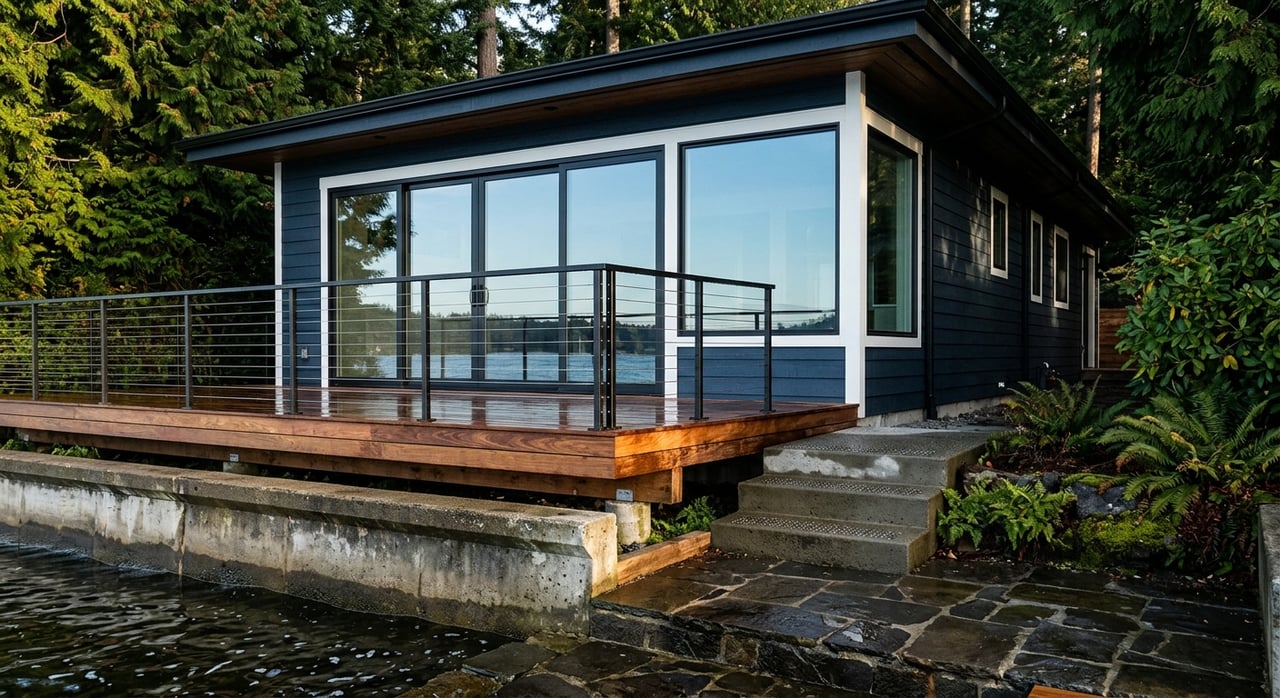
If you have been eyeing Kirkland waterfront property, you already know this is not a casual search. Inventory is limited, price points vary widely, and the details that matter most often sit below the surface, from shoreline rules to dock history to renovation feasibility. In this market, the buyers who do best are the ones who understand both the lifestyle and the due diligence. Let’s dive in.
Kirkland waterfront market right now
Kirkland’s waterfront inventory is small and specialized. As of May 24, 2026, there were 28 waterfront homes for sale, with a median listing price of $1.3 million, an average of 41 days on market, and 1 offer on average in this niche segment.
That may sound slower than the broader market, but waterfront is not a typical category. Each property can differ sharply in shoreline access, improvements, condition, and permit history, so buyers often spend more time evaluating the site itself, not just the home.
In the broader Kirkland market, homes were selling much faster. Redfin reported a median sale price of $1.375 million in March 2026, with homes selling in about 13 days and receiving an average of 2 offers.
That contrast matters. Even if a waterfront listing sits longer, a well-located property with strong fundamentals can still move quickly when the right buyer recognizes the opportunity.
Waterfront price points in Kirkland
One of the biggest misconceptions about waterfront property is that it all lives in the same price band. In Kirkland, today’s inventory shows several clear entry points depending on the type of access and ownership experience you want.
Entry-level waterfront options
Access-oriented condos and smaller units are currently showing up around $479,000 to $795,000. These can be a practical way to get close to the water without taking on the cost and complexity of direct shoreline ownership.
For some buyers, this is the right first move. If your goal is a lake-oriented lifestyle and lower maintenance, this tier can offer a meaningful entry into the market.
Mid-tier lake-view choices
Mid-range waterfront or lake-view condos are running roughly $945,000 to $2.398 million. In this range, you may find stronger views, better positioning, or a more polished overall product.
This category can appeal if you want a balance of location, views, and convenience. It may also make sense if your budget does not stretch to direct-water ownership but you still want a premium Kirkland setting.
Direct-water and estate properties
Direct-water homes and estate properties are currently ranging from about $3.35 million to $10 million. These homes often carry the greatest upside in lifestyle value, but they also tend to come with the most site-specific complexity.
When you are shopping at this level, the house is only part of the equation. Shoreline conditions, bulkheads, dock status, and future improvement potential can all affect value.
Land and redevelopment opportunities
Rare land or development opportunities are also appearing, starting around $1.5 million. These can be compelling for buyers focused on long-term upside, but they typically require a more advanced review of permits, feasibility, and site constraints.
If you are thinking about redevelopment, you should assume the process will involve more than standard residential due diligence. On Kirkland waterfront sites, the path from concept to approval is rarely simple.
What buyers should prioritize first
In a market like this, your first decision should not be price alone. You will usually get better results by defining what “waterfront” actually means to you before you start chasing listings.
For example, you may care most about one of these priorities:
- private dock access
- beach access
- stronger view orientation
- privacy
- redevelopment potential
- lower-maintenance condo living near the lake
That choice shapes everything that follows. In Kirkland, the right price point usually follows your shoreline goals, not the other way around.
Why the site matters as much as the house
With Kirkland waterfront property, the site often matters as much as the structure. A home with dated finishes may still be a strong buy if the shoreline fundamentals are solid and the renovation path is realistic.
On the other hand, a beautiful house can become more complicated if the dock, bulkhead, grading, or prior shoreline work creates permit or repair questions. That is why disciplined buyers look beyond staging and focus on the property’s long-term usability.
For renovation-minded buyers, this is where practical construction knowledge can make a real difference. You want to understand not just what the home is today, but what the property can realistically become.
Kirkland shoreline rules buyers need to know
Kirkland’s Shoreline Master Program applies to land within 200 feet of Lake Washington’s ordinary high water mark, as well as wetlands connected to Juanita Bay and Yarrow Bay. For waterfront buyers, that means many common improvement ideas can fall under shoreline regulation.
The city says shoreline review can apply to new or expanded structures, grading, dredging or filling, bank stabilization, trail construction, and changes to public access. Existing lawful uses may be repaired and maintained, but expansions or alterations can trigger review.
This distinction is important. A simple repair is not the same as an addition, and a maintenance project is not the same as a major remodel.
Public access and shoreline use
Kirkland notes that public-access standards apply to new development. The city also references the public trust doctrine, which protects public use of navigable water bodies without allowing trespass across private uplands.
For buyers, the practical takeaway is this: waterfront ownership gives you unique access and value, but it does not erase public shoreline rules or create unlimited freedom to modify the site. You want clarity on those boundaries before you commit.
Permit paths can vary
For waterfront projects, Kirkland requires either exemption review or a permit path. Even exempt projects still require a city exemption application.
For non-exempt proposals, the city may require a Shoreline Substantial Development Permit. Some projects may also require a Conditional Use Permit or Variance, and shoreline permits with a public process require a pre-submittal meeting before application.
The city also notes that agencies such as the Army Corps of Engineers and Washington Department of Fish and Wildlife may add comments or conditions. In other words, permit timing and complexity can expand quickly depending on the scope of work.
Docks, bulkheads, and shoreline stabilization
Docks and bulkheads deserve special attention during a Kirkland waterfront purchase. These features can be central to the property’s value, but they can also be some of the most important items to verify before you write an offer.
Kirkland treats pier repairs, bulkhead repair, and shoreline stabilization differently. The city says pier work has major-versus-minor repair thresholds, and bulkhead standards are separate.
There is also an important detail for some homes close to the lake. Kirkland says a bulkhead protecting an existing home within 10 feet of the lake does not require a demonstration of need.
The city further states that replacing hard shoreline stabilization with soft shoreline stabilization or a natural shoreline is preferred and exempt from a Shoreline Substantial Development Permit. That preference can matter if you are evaluating future repair options and long-term shoreline strategy.
Due diligence before making an offer
On a standard home purchase, buyers often focus on condition, price, and inspection findings. On Kirkland waterfront property, your due diligence should go deeper.
The city’s exemption checklist asks for a property survey, and the shoreline permit checklist asks applicants to document existing structures and improvements waterward of the ordinary high water mark. That makes surveys, permit history, and prior shoreline modifications especially important.
Before moving forward, you should try to understand:
- whether there is a current property survey
- what shoreline permits or exemptions exist
- whether the dock, bulkhead, or shoreline work was previously approved
- what structures or improvements sit waterward of the ordinary high water mark
- whether past remodel work may have triggered review
- what future improvements may be limited by shoreline rules
This is one of the biggest differences between buying a conventional home and buying waterfront. The physical site and its paper trail matter in equal measure.
Older waterfront homes and renovation plans
Many older lake homes in Kirkland can be attractive renovation candidates. If you are open to cosmetic work or a larger remodel, you may find better location fundamentals than you could in a fully updated home.
Still, the city makes a clear distinction between repair, alteration, and rebuilding. Existing lawful shoreline structures may be repaired and maintained, but additions, expansions, grading, and similar changes can trigger shoreline review and other permits.
That means a teardown or major rebuild is usually not a simple construction project. It is often a permit-heavy process with more layers than buyers expect at first glance.
Critical area review can add complexity
Kirkland’s critical-area rules can add another step to your evaluation. The city defines geologically hazardous areas as land susceptible to landslides, severe erosion, or liquefaction, and work in those areas requires a critical area permit.
The city also says properties within 125 feet of streams and 300 feet of wetlands should be assessed by a qualified professional. Buyers are encouraged to use the city’s GIS maps and contact staff early.
For waterfront property, that is a practical reminder that natural-site conditions are part of the deal. If you are considering major changes, early review can help you understand risk, timing, and cost.
Demolition is not just demolition
If your plan includes a teardown, Kirkland’s demolition permit process matters. The city requires a demolition plan, asbestos notification before permit issuance, and rodent abatement documentation.
The city also notes that an environmental checklist may be required for environmentally sensitive sites. For buyers, that means older waterfront redevelopment projects can be more schedule-sensitive than a typical home renovation.
How to compete in today’s market
Even though waterfront is a niche category, Kirkland buyers should still treat it as a fast-moving, high-scrutiny market. The broader city remains competitive, and some homes still attract multiple offers with waived contingencies.
That does not mean you should rush blindly. It means you should be financially and strategically prepared before the right property appears.
A smart waterfront buying approach often includes:
- getting pre-approved or pre-underwritten before touring
- deciding your must-haves before you start writing offers
- setting your comfort level for inspection, financing, and permit risk
- moving quickly when a property matches your shoreline priorities
- staying open to cosmetic updates if the site fundamentals are strong
In this segment, waiting for a perfect home can cost you a very good one. If a property fits the shoreline, access, and renovation profile you want, speed and clarity matter.
How to balance view, access, and budget
The right Kirkland waterfront purchase is rarely about checking every box. More often, it is about making intentional tradeoffs.
If daily lake use matters most, direct access may deserve a larger share of your budget. If your priority is a visual connection to the water, a lake-view condo or home may create better value.
If your long-term goal is renovation or redevelopment, you may be better served by a property with strong location fundamentals and room for improvement, even if the finishes are dated today. In many cases, the smartest buy is the one that aligns most clearly with how you plan to use the property over time.
A practical path for serious buyers
If you are serious about buying waterfront in Highlands and greater Kirkland, start by narrowing your shoreline goals. Then evaluate each opportunity through three lenses: lifestyle fit, site complexity, and realistic improvement potential.
That process helps you avoid two common mistakes. First, overpaying for features you do not actually need. Second, underestimating the time and diligence required for a property with shoreline or renovation complexity.
The best waterfront purchases are usually not the ones with the flashiest first impression. They are the ones where the location, access, and property fundamentals hold up under careful review.
If you want a clear, grounded strategy for buying Kirkland waterfront property, Stephanie Stanford can help you evaluate value, condition, and renovation potential with a calm, detail-focused approach.
FAQs
What is the current waterfront inventory in Kirkland?
- As of May 24, 2026, Redfin showed 28 waterfront homes for sale in Kirkland, with a median listing price of $1.3 million, 41 days on market, and 1 offer on average.
What price range should you expect for Kirkland waterfront homes?
- Current inventory ranges from about $479,000 to $795,000 for access-oriented condos and smaller units, roughly $945,000 to $2.398 million for mid-tier waterfront or lake-view condos, and about $3.35 million to $10 million for direct-water homes and estate properties.
What shoreline rules apply to Kirkland waterfront property?
- Kirkland’s Shoreline Master Program applies to land within 200 feet of Lake Washington’s ordinary high water mark and regulates many activities, including new or expanded structures, grading, filling, bank stabilization, and some public access changes.
What should you verify before buying a Kirkland waterfront home with a dock or bulkhead?
- You should review the property survey, shoreline permit history, documentation for existing structures waterward of the ordinary high water mark, and the status of prior dock, bulkhead, or shoreline work.
What should buyers know about renovating older Kirkland lake homes?
- Kirkland allows existing lawful shoreline structures to be repaired and maintained, but additions, expansions, grading, demolition, and rebuilding can trigger shoreline review, critical-area review, and other permit requirements.
How can you compete for waterfront property in today’s Kirkland market?
- The strongest buyers usually get pre-approved or pre-underwritten early, define their must-haves before touring, set limits around inspection and permit risk, and move quickly when a property matches their shoreline priorities.